

Blog Details
ORGATEC India 2026
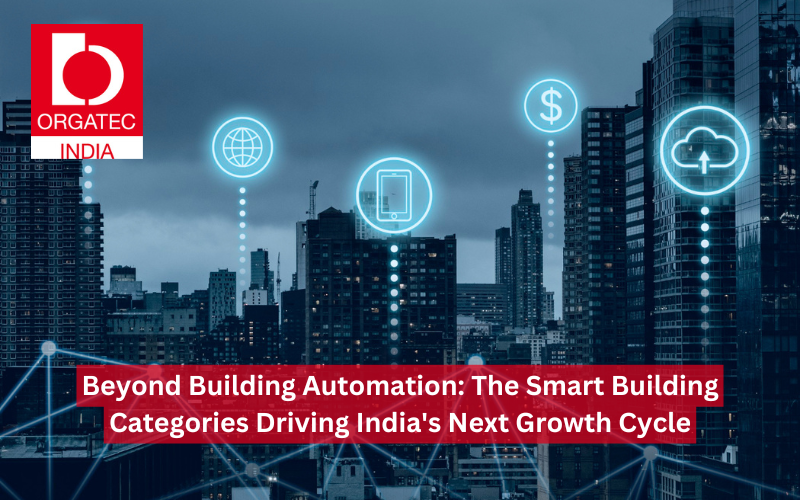
Beyond Building Automation: The Smart Building Categories Driving India's Next Growth Cycle
Share Page
ORGATEC India | Workplace Technology · Smart Buildings · System Integrators · 2026
India's smart building market is not coming. It is already here - and it is moving faster than most integrators have adjusted their portfolios to match.
The numbers are clear. The demand is real. And the window to position ahead of the curve is open right now.
The Market You Are Operating In
India's smart building and building automation sector is valued at USD 12–15 billion in 2026, growing at double-digit CAGR through 2030. The commercial office segment is the single largest demand driver - fuelled by over 1,900 GCCs, record office leasing of 35.7 million sq ft in H1 2026 alone, and a corporate India that has moved decisively toward ESG-aligned, technology-enabled infrastructure.
Johnson Controls, Siemens India, Honeywell Buildings, and Schneider Electric India are all scaling their India operations to meet this demand. The projects are live. The budgets are approved. The specifications are being written - with or without your input.
The integrators capturing this growth are the ones who moved into these categories early. Here is where the fastest growth is happening right now.
1. Workspace Technology - The Category Accelerating Ahead of Everything
At ORGATEC India 2025, 1,948 visitors came specifically to source workspace technology - making it one of the highest-interest categories on the entire show floor. These were not exploratory browsers. They were IT heads, facility managers, smart office leads, and CRE professionals with active projects and live vendor shortlists.
What they were looking for:
Hybrid AV and unified communications - The hybrid meeting experience is still broken in most Indian offices. AI-tracking cameras, ceiling microphone arrays, and DSP-enabled room systems certified for Microsoft Teams Rooms and Zoom Rooms are now the baseline specification in any serious GCC campus. The gap between what most offices have and what they need is enormous - and system integrators who have built competency here are closing deals fast.
Desk booking and workplace management platforms - Robin, Condeco, and OfficeRnD are seeing rapid adoption across India's hybrid-ready GCC campuses. The organisations integrating these platforms with access control, occupancy sensors, and HR systems are the ones delivering real utilisation intelligence - and they are working with integrators who understand the full stack.
Occupancy analytics and IoT sensor networks - Real-time space utilisation data is now a procurement requirement for any new GCC fit-out above 50,000 sq ft. The ability to tell a client exactly how their space is being used - floor by floor, zone by zone, hour by hour - and to tie that data to energy management decisions, is the capability that separates tier-one integrators from the rest.
AI-powered facility management platforms - Facilio, IBM Maximo, and Planon are gaining significant traction in India's commercial building market. Predictive maintenance, automated work order routing, energy optimisation - these platforms are delivering 15–30% energy savings in Grade-A buildings. For integrators, this is not a future opportunity. It is a current one.
2. Acoustic Solutions - The Specification Shift Nobody Predicted
1,434 visitors sourced acoustic solutions at ORGATEC India 2025. That number was one of the most significant surprises from the post-show data - and it makes complete sense when you understand what is driving it.
Open-plan GCC offices are the default fit-out format in India's commercial real estate market. And open-plan offices, deployed without acoustic strategy, create an environment where cognitive performance suffers, privacy is absent, and hybrid meetings are a source of frustration rather than productivity.
The correction is now underway - and it is moving through product categories that system integrators are not traditionally associated with but are increasingly being asked to integrate.
Sound masking systems - Digital emitter networks that raise the ambient noise floor to a frequency that masks speech intelligibility. These are now standard specification in financial services, legal, and high-density GCC open-plan environments. Cambridge Sound Management and Soft dB are among the brands establishing presence in India. Installation and commissioning is a technical process - and integrators who understand the system architecture are the natural delivery partner.
Smart acoustic pods and enclosures - Phone booths and meeting pods with integrated power, data, ventilation, and IoT connectivity are now being treated as networked devices on a building floor, not just furniture. The ability to monitor pod utilisation in real time, integrate with desk booking platforms, and manage air quality within the enclosure brings the acoustic pod into the system integrator's natural scope.
Acoustic performance monitoring - Real-time measurement of noise levels by zone, feeding into BAS and FM dashboards, is an emerging category in India's most sophisticated commercial fit-outs. The technology exists. The demand is building. The integrators who position here now will own the category when it becomes standard.
What Is Driving This Demand - and Why It Continues
GCC expansion is the primary engine. India's GCC market is projected to reach USD 105 billion in revenue by 2030, with 2,500+ centres employing 2.5 million professionals. Every new campus is a full technology specification opportunity - BAS, AV, workspace management, acoustic systems, IoT infrastructure.
ESG mandates are creating mandatory technology investment. India's revised Construction and Demolition Waste Rules, ECBC 2017 compliance requirements, and growing LEED/WELL certification pipelines are all creating specification requirements that flow through to technology infrastructure. Energy management systems, indoor air quality monitoring, smart metering, and EV charging management are all categories where integrator competency is now a procurement criterion.
Hybrid work has permanently elevated the AV and connectivity specification. Cisco India, Poly, and Jabra are all seeing sustained demand growth from India's corporate and GCC market. The organisations that got their hybrid AV wrong in 2022–2023 are now replacing it - with higher specifications, bigger budgets, and a much better understanding of what they actually need.
The research community is catching up. Firms including NASSCOM, JLL, CBRE India, Colliers India, and Knight Frank India are all publishing India-specific workplace technology research that is landing on the desks of CREs and CXOs who are then asking their technology partners for solutions they have never been asked to deliver before.
The demand signal is consistent. The briefs are changing. The budgets are following.
The Opportunity Gap
Here is the honest observation: most system integrators in India are still leading with the categories they built their business on five years ago. AV. Access control. CCTV. Structured cabling. Network infrastructure.
These categories are not declining. But the fastest-growing categories - workspace management platforms, acoustic system integration, AI-powered FM, IoT sensor infrastructure, occupancy analytics - are being captured by the integrators who expanded their portfolio early, built the right partnerships, and positioned themselves as workplace technology advisors rather than installation contractors.
The window to make that move is still open. The market is still in its early phases of adoption. The clients who will deploy these systems at scale over the next three years are right now building their vendor shortlists.
Where the Market Intelligence Comes From
For research firms and technology consultants, understanding where the Indian workplace technology market is heading requires more than secondary data. It requires proximity to the actual buying decisions - the specifications being written, the products being evaluated, the conversations happening between buyers and solution providers in real time.
ORGATEC India 2026 is the most concentrated source of that intelligence available in the Indian market. Over 9,000 qualified professionals in one building over three days - sourcing, comparing, specifying, and deciding across every smart workplace category. The post-show data from 2025 - granular category interest, visitor role mix, sourcing intent - is the kind of primary market intelligence that takes months to replicate through traditional research methods.
For integrators, it is three days of live competitive intelligence, direct brand access, and the ability to evaluate every relevant product category side by side. For research firms and consultants, it is the most efficient field research environment in the Indian workplace industry calendar.
The Fastest-Growing Market in India's Commercial Sector Is on One Show Floor
ORGATEC India 2026. 19–21 November. Jio World Convention Centre, BKC, Mumbai.
Workspace technology. Acoustic solutions. Building automation. Smart building infrastructure. AI-powered facility platforms. IoT and occupancy analytics. All under one curated roof - with the buyers, the specifiers, and the brands that are defining where this market goes next.
The integrators and consultants in this room in November are the ones writing the next chapter of India's smart building story.
Register as a Visitor → register.orgatec-india.com
Free professional registration. India's only dedicated workplace and facility innovation exhibition.
More Blogs