

Blog Details
ORGATEC India 2026
Biophilic Design at Commercial Scale: How India's Largest Office Campuses Are Bringing Nature Indoors
Share Page
By ORGATEC India | WorkNXT Series | Workplace Design · ESG · Employee Experience
There is a particular kind of afternoon that happens in every open-plan office in India. Around 2:30 pm. The air conditioning has been running since 8am. The overhead lights haven't changed since the building was commissioned. The ceiling is white. The carpet is grey. The walls are white. There is not a single living thing in eyeshot - no plant, no view of sky, nothing that breathes or grows or changes.
And in this environment, the 400 people on the floor are expected to produce the kind of focused, creative, high-quality work that India's GCC economy is staking its global reputation on.
It is a strange expectation. Because the human brain - the same brain responsible for every product feature, every financial model, every engineering breakthrough being delivered from an office in Bengaluru or Hyderabad - did not evolve in a white room under fluorescent light. It evolved over hundreds of thousands of years in forests, on riverbanks, in grasslands, under open sky.
And it still remembers.
What Biophilic Design Actually Is - and What It Isn't
Biophilic design is not a mood board aesthetic. It is not the decision to add a line of succulents to the reception desk, or to print a tropical-leaf wallpaper in the breakout room.
The term biophilia was popularised by the evolutionary biologist E.O. Wilson in 1984 - the idea that human beings have an innate, biological affinity for living systems and natural environments. We are not simply drawn to nature because it looks nice. We are drawn to it because our nervous systems are calibrated to it. The presence of natural elements - plants, water, natural light, organic materials, views of sky and landscape - activates a fundamentally different neurological state than a sealed, artificial environment.
Biophilic design is the discipline of bringing that neurological calibration deliberately into built spaces. It is the application of specific, evidence-based design principles that reconnect the people inside a building with the natural patterns and stimuli their biology was built to respond to.
At commercial scale - in a 300,000 square foot GCC campus, a multi-tower IT park, a Grade-A headquarters building - this is not a gesture. It is a strategy. And the data behind it is no longer soft or anecdotal. It is peer-reviewed, multi-country, and commercially measurable.
The Fourteen Patterns - and the Seven That Change Buildings
The academic framework most widely used in commercial biophilic design practice comes from the work of Stephen Kellert, whose fourteen patterns of biophilic design form the basis of specification guidance used by firms including Gensler, HOK, and Perkins&Will in their commercial workplace projects globally.
The fourteen patterns span a wide range - from visual connection with nature and presence of water, through to concepts like prospect and refuge, mystery, and risk/peril. Not all of them are commercially deployable at scale. But seven of them are, and they are the ones that Indian GCC campuses, corporate headquarters, and Grade-A commercial fit-outs are increasingly specifying as standard.
1. Visual Connection with Nature - The most fundamental and most impactful. Access to views of plants, landscape, sky, or water from the primary workspace. Floor-to-ceiling glazing with views of a planted courtyard. Living walls visible from workstations. Atrium gardens that anchor the visual experience of an entire building.
2. Dynamic and Diffuse Light - Natural light that changes through the day: shifting in intensity, direction, and colour temperature as the sun moves. Not fixed 4,000K overhead fixtures from 8am to 8pm. Human-centric lighting systems that mimic the dynamic quality of natural light are the technological expression of this pattern where daylighting alone cannot reach deep floor plates.
3. Presence of Water - Water features in reception and atrium spaces. The sound of moving water as acoustic backdrop in collaboration zones. Interior fountains, reflection pools, and planted water gardens. The auditory dimension of water - the specific frequency range of flowing water - has measurable stress-reduction effects distinct from white noise or music.
4. Biomorphic Forms and Patterns - Organic curves, fractal geometries, and patterns derived from natural forms in furniture, flooring, ceiling elements, and wall surfaces. The spiral of a nautilus shell in a reception desk profile. The branching pattern of a tree translated into a structural ceiling feature. The irregular hexagonal geometry of a honeycomb expressed in a feature wall tile. These patterns reduce what environmental psychologists call visual stress - the fatigue induced by the perfectly rectilinear, geometrically rigid environments that most commercial offices create.
5. Material Connection with Nature - Timber, stone, cork, bamboo, clay, raw wool, linen - materials with visible grain, texture, and natural variation. The shift away from laminate, powder-coat, and polished surface toward materials that carry evidence of their natural origin. Interface - whose Human Spaces research has become one of the most cited datasets in commercial biophilic design - has built an entire product line around bringing the visual texture of natural systems into commercial floor coverings.
6. Prospect - The ability to survey space from an elevated or open vantage point. Double-height atriums that create a sense of openness and scale. Mezzanine levels overlooking planted courtyards. Raised collaborative areas with long sightlines across the floor plate. Prospect addresses a fundamental human need for spatial orientation - the ability to understand where you are in relation to your surroundings.
7. Refuge - Enclosed, sheltered spaces that provide a sense of protection and withdrawal. Acoustic pods lined with soft, natural materials. Reading nooks with high-backed seating. Quiet rooms with reduced visual stimulation and natural material palettes. Refuge and prospect work together - the most sophisticated commercial interiors offer both, allowing people to move between open, surveying spaces and enclosed, restorative ones.
The Research Case: What the Numbers Actually Say
This is no longer a conversation about feelings. It is a conversation about data - and the data is, at this point, substantial enough to be commercially decisive.
The Human Spaces global report, which surveyed more than 7,600 office workers across 16 countries, found that employees working in environments with natural elements reported 15% higher wellbeing, 6% higher productivity, and 15% greater creativity than those in conventional office settings.
That study was led by Professor Sir Cary Cooper, CBE - organisational psychologist, professor at Alliance Manchester Business School, and one of the most widely cited workplace researchers globally - and commissioned by Interface. It remains the largest global survey of biophilic design outcomes in commercial workplace environments.
Six percent productivity. Fifteen percent creativity. These are not marginal numbers. Applied to a 500-person GCC campus, a 6% productivity improvement means the equivalent of 30 additional people's output - without hiring a single person.
The Indian Institute of Human Settlements conducted a study in 2025 which shows that integrating natural elements into offices can improve employee mental well-being by up to 21% and cut workplace stress by 34
Knight Frank India's 2024 Workplace Report states that Indian companies saw 14% higher employee retention rates with biophilic offices than those with standard corporate designs.
Fourteen percent higher retention. In a market where replacing a senior GCC professional costs between 50% and 100% of their annual salary - where Goldman Sachs, JPMorgan, and Microsoft are competing for the same pool of AI, cloud, and engineering talent - a 14% retention improvement is a strategic differentiator, not a design preference.
A systematic review synthesising evidence from 74 peer-reviewed papers found that 39 studies investigated the effect of workplace biophilic design on cognitive performance related to productivity, creativity, working memory, attention, information processing, and divergent thinking. 30 studies (40.5%) reported results with changes in stress levels, measured through heart rate, heart rate variability, skin conductance, blood pressure, brain activity (alpha waves), and salivary cortisol.
Salivary cortisol - the most direct biological marker of stress - measurably reduced by exposure to biophilic environments. Not self-reported. Biochemically measured.
India's Biophilic Design Moment
According to a 2025 report by the Indian Institute of Interior Design (IIID), India's biophilic design market has seen a 28% surge in project demand, with the average design budget rising significantly for high-end urban projects.
This surge is not accidental. It is the convergence of three forces:
The GCC quality imperative. India's 1,900+ GCCs are not building back offices. They are building global innovation hubs that need to attract and retain the country's most competitive talent. India maintained its third global ranking for LEED certifications in 2024, with 370 projects covering 8.5 million gross square metres. A building that is pursuing LEED or WELL certification is, by definition, engaging with biophilic design - because both standards explicitly reward the integration of natural elements, daylighting access, and material connection with nature.
The post-pandemic office proposition. In a hybrid work model, the office must earn the commute. The most powerful reason an employee chooses to come in - rather than work from home - is the quality of the environment. The biophilic office offers something no home setup can easily replicate: a curated, living, sensory-rich environment that actively restores focus and generates creative energy.
The ESG mandate. Many leading manufacturers now produce panels with high recycled content and low VOC emissions, contributing to better indoor air quality. The growing stringency of building codes and the rising corporate emphasis on ESG goals are making sustainable, reusable interior solutions an increasingly standard choice. Biophilic design - through its emphasis on natural materials, living systems, daylighting, and reduced reliance on artificial environmental control - aligns directly with the ESG reporting frameworks that India's largest corporates are now legally required to address.
Living Walls: The Signature Element - and the Most Misunderstood One
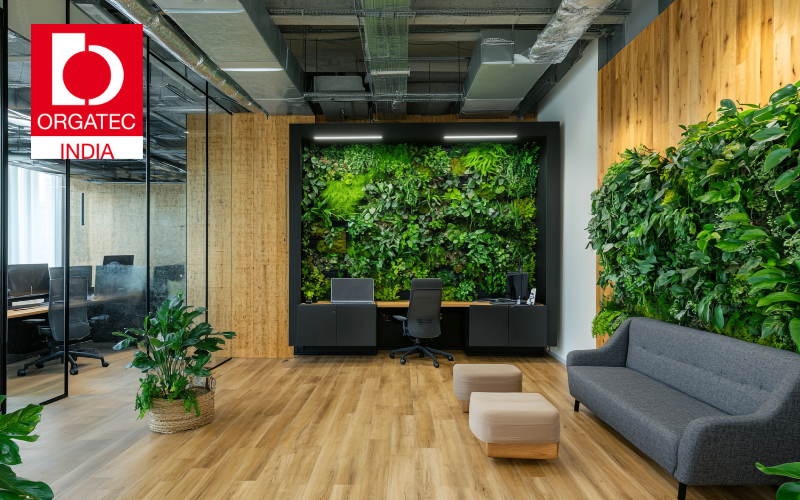
A living wall - also called a vertical garden, green wall, or plant wall - is the element most associated with biophilic design in Indian commercial interiors. It is also the element that most frequently goes wrong when specified without adequate horticultural or irrigation expertise.
Done well, a living wall in an Indian corporate office is one of the most powerful design moves available: a floor-to-ceiling installation of living plants that simultaneously delivers visual impact, acoustic absorption, IAQ improvement, and thermal regulation. Done badly, it is an expensive installation of dead or dying plants that becomes a maintenance liability within six months.
Plant selection for Indian climate is the first and most important decision. The specific combination of high ambient temperatures, seasonal humidity extremes, and indoor air conditioning creates an environment unlike any European or American living wall reference project. The plants that thrive in an air-conditioned Indian office include:
Pothos / Money Plant (Epipremnum aureum) - arguably the most resilient plant available in the Indian market. Tolerates low light, irregular watering, and temperature variation. A workhorse for living wall lower sections where light penetration is limited.
Peace Lily (Spathiphyllum wallisii) - consistently performs well in Indian office conditions, tolerates low light, and is one of the most effective plants for absorbing VOCs from synthetic materials including formaldehyde, benzene, and xylene.
Snake Plant / Sansevieria (Dracaena trifasciata) - releases oxygen at night as well as during the day, exceptionally drought-tolerant, and performs reliably under the temperature differentials between AC zones and non-AC spaces.
Areca Palm (Dypsis lutescens) - a natural humidifier, effective at raising relative humidity in over-dried air-conditioned environments. One of the top-performing plants for VOC absorption as validated by NASA's Clean Air Study - still the foundational reference for IAQ-focused plant selection despite its 1989 publication date.
ZZ Plant (Zamioculcas zamiifolia) - thrives in low light conditions and can tolerate weeks without water. One of the most maintenance-efficient options for Indian living wall systems where watering consistency cannot be guaranteed.
Irrigation systems for commercial living walls in India typically operate on one of two models: direct irrigation (a closed-loop drip system fed from a central water tank, with nutrient dosing integrated into the irrigation schedule) or hydroponic substrate (plants grown in a mineral wool or polymer substrate panel rather than soil, with nutrient-rich water circulated through the system). Both require professional commissioning and monthly horticultural maintenance. The maintenance contract - including plant replacement, system flushing, and seasonal nutrient adjustment - should be budgeted at 15–25% of the installation cost annually.
Facing orientation matters significantly in Indian commercial buildings. A living wall on a west-facing interior wall in Bengaluru, behind north-facing glazing, receives fundamentally different light conditions from the same system installed in a Mumbai tower with southern glazing. Every specification should be preceded by a light-level audit - typically a three-day measurement exercise using a lux meter at multiple heights and times of day.
Atriums, Courtyards, and Rooftop Greenery: Nature at Building Scale
The most transformative biophilic installations in Indian commercial architecture are not on a single floor. They are woven through the building's spatial organisation.
Infosys has long been the most visible example of large-scale biophilic thinking in Indian campus design - its Mysuru campus, covering over 300 acres, integrates lakes, gardens, and extensive natural landscaping into the working environment in a way that has influenced how Indian corporate real estate thinks about the relationship between built and natural space.
Wipro's campuses across Bengaluru and Hyderabad have similarly prioritised green cover, courtyard gardens, and pedestrian routes through planted landscapes as core elements of their employer brand proposition.
Amazon India's development projects in Hyderabad and Bengaluru have incorporated significant vertical and horizontal green elements - drawing on the parent company's global commitment to biophilic workplace design, exemplified in the famous Amazon Spheres in Seattle.
Atrium gardens - planted central voids that rise through multiple floors of a building - create the most immersive commercial biophilic experience available in Indian architecture. The atrium functions simultaneously as a visual anchor (every floor has a view into a living, changing space), a natural light distributor (a glazed atrium roof delivers daylight 8–12 storeys below), an acoustic modifier (the sound absorption and diffusion properties of planting reduce echo in hard-surfaced spaces), and a thermal regulator (evapotranspiration from massed planting cools the atrium air through natural humidity release).
Courtyard integration - particularly relevant for new campus developments in Bengaluru, Hyderabad, and Pune where land enables the building form - brings a classic Indian architectural tradition (the internal courtyard as living heart of a building) into the vocabulary of contemporary commercial design. Well-designed courtyard gardens provide visual connection with nature for an entire building perimeter, create protected outdoor spaces for informal collaboration and restoration, and reduce the overall mechanical cooling load by moderating the thermal mass of the surrounding structure.
Rooftop greenery - from simple planted pergola zones to full intensive roof gardens - is increasingly specified in Indian Grade-A commercial buildings as a combined ESG credential, occupant amenity, and urban heat island mitigation strategy. Architects draw inspiration from the natural world to create functional and beautiful environments like rooftop gardens, green spaces, and integrated courtyards, which promote relaxation and mindfulness while creating spaces for meditation, yoga, and wellness-focused activity.
The IAQ Connection: Plants That Clean the Air You Breathe
In India's urban commercial buildings - where PM2.5 levels regularly exceed WHO guidelines, where formaldehyde off-gasses from new furniture and adhesives, and where CO₂ concentrations in sealed air-conditioned spaces can reach levels that measurably impair cognitive performance - the IAQ benefits of interior planting are not decorative. They are functional infrastructure.
The mechanism is well understood: plants absorb CO₂ and release oxygen through photosynthesis. They absorb VOCs (volatile organic compounds) - including formaldehyde, benzene, xylene, and toluene, all of which are emitted by synthetic furniture, adhesives, paints, and carpets - through a process called phytoremediation, in which the VOC is absorbed through the leaf surface and broken down in the root zone by soil microorganisms.
Living walls enhance aesthetics, improve air quality, and create a calming environment. Benefits include increased oxygen levels, reduced stress, and a natural sound barrier function.
For spaces pursuing WELL Building Standard certification - and the number of Indian organisations pursuing WELL is growing at 40% year on year, according to the International WELL Building Institute - interior planting contributes directly to the WELL Air concept, specifically to features related to VOC management, pollutant source control, and occupant comfort.
The IAQ improvement from biophilic installation is not a replacement for a well-designed HVAC system with appropriate fresh air rates. It is a complementary layer - one that improves the quality of the air that the HVAC system circulates, and reduces the burden on that system by absorbing chemical pollutants that filters alone cannot address.
The Cost Spectrum: From Potted Plants to Full Living Campus
Here is the investment reality that every procurement head and CRE director needs to understand before the biophilic line item gets value-engineered out of the specification.
Tier 1 - Potted Plant Strategy: ₹500–3,000 per sq ft of green coverage Strategically curated potted plants in reception, breakout zones, and open plan areas. Areca palms in high-traffic zones. ZZ plants and Pothos in workstation clusters. Peace lilies in meeting rooms. Monthly horticultural maintenance contract. Measurable IAQ benefits. Meaningful visual connection with nature at minimum capital cost. The ROI on this tier is largely in wellbeing and retention. Payback period: essentially immediate, because the investment cost is low enough that even a marginal improvement in retention justifies it within the first quarter.
Tier 2 - Feature Living Wall: ₹4,500–12,000 per sq ft A signature installation in reception, a major meeting room, or a primary collaboration zone. 20–50 sqm of planted vertical surface. Professional irrigation system. Annual maintenance contract. The visual and brand impact at this tier is significant - a well-executed living wall at the reception of a GCC headquarters communicates a specific set of values to every client, visitor, and new employee who walks through the door. Payback: linked to recruitment and retention metrics, and to the ESG and certification credits the installation generates.
Tier 3 - Integrated Biophilic Design: ₹15,000–40,000 per sq ft of specialist installation Living walls across multiple zones, atrium gardens, planted courtyard integration, biomorphic material specification, water features, circadian lighting systems, and rooftop green zones. This is biophilic design as a building strategy - not a decorative addition. The organisations specifying at this level are typically pursuing LEED, WELL, or IGBC certification and treating the biophilic investment as part of the certification ROI calculation. The combined benefit - rental premium for certified buildings, documented employee retention improvement, reduced HVAC load from planting, ESG reporting credentials - produces a payback period of three to five years in most Grade-A commercial contexts.
The WorkNXT Experience Pillar: Why Nature Is the Most Human Technology in the Office
At ORGATEC India 2026, the WorkNXT Experience pillar is built on one conviction: that the most important technology in a workplace is not the one that connects to the internet. It is the one that connects to the human being inside the building.
Biophilic design is, in this sense, the oldest technology in our design toolkit - and simultaneously the one with the most rigorous contemporary evidence base. It works because it addresses the human being at a level that no furniture specification, no AV system, and no desk booking platform can reach: the neurological level. The level at which stress is reduced before it becomes a sick day. The level at which creativity is unlocked before it becomes an innovation meeting. The level at which belonging is felt before it becomes a retention statistic.
The Indian Institute of Human Settlements' 2025 study shows that integrating natural elements into offices can improve employee mental well-being by up to 21% and cut workplace stress by 34%. These numbers are not architectural theory. They are the organisational outcomes of a design decision - the decision to bring nature inside, at scale, with intention. Unison Risk Advisors
At ORGATEC India 2026 - 19–21 November, Jio World Convention Centre, Mumbai - biophilic design solutions, landscaping partners, plant installation specialists, living wall manufacturers, and the architects and designers who specify them will be on one curated show floor. For the organisations building India's next generation of GCC campuses and corporate workplaces, this is where the biophilic brief becomes a biophilic specification.
Because the question is no longer whether nature belongs in the office.
The question is how much of it you're leaving out.
📅 19–21 November 2026 | Jio World Convention Centre, Mumbai 🌐 www.orgatec-india.com
For exhibition and sponsorship enquiries: Manoj Nandiot - m.nandiot@koelnmesse-india.com | +91 98339 31376
Biophilic Design India | Living Wall India | Office Plants India | Biophilic Office Design | Green Building India | WELL Certification India | Indoor Air Quality Office | Workplace Wellness India | WorkNXT | ORGATEC India 2026 | GCC Campus Design | Commercial Interior Design India | Sustainable Office Design India | Biophilic Design GCC | Nature Office Design
Biophilic design is delivering 15% higher creativity, 21% better wellbeing, and 14% higher retention in Indian offices. Here's everything your campus needs - from living walls to atrium gardens - and the ROI behind every rupee invested. By ORGATEC India 2026.
biophilic design India office | living wall commercial India | biophilic office design GCC | WELL certified office India | indoor plants office IAQ India
More Blogs