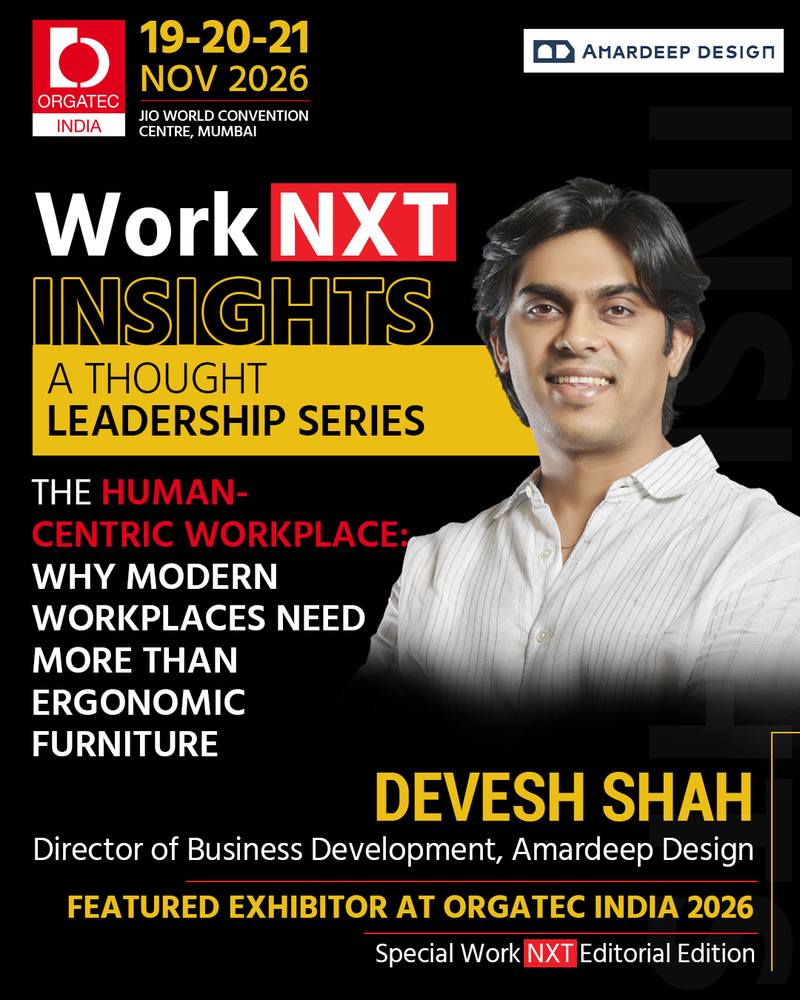


WorkNXT Insights Article
THE HUMAN-CENTRIC WORKPLACE: WHY MODERN WORKPLACES NEED MORE THAN ERGONOMIC FURNITURE
The Human-Centric Workplace: Redefining Productivity
For years, offices were planned around headcount. How many desks could fit on the floor? How many meeting rooms could be accommodated? How efficiently could the available square footage be used?
These questions shaped workplace design, often leaving one important consideration out of the equation: the people who use these spaces every day.
Our understanding of productivity evolves with our nature of work. At Amardeep Design, we believe in creating environments that respond to people’s needs, support their well-being, accommodate different working styles and adapt to the changing demands of work.
The Human Element of Workplace Design
Productivity is not a constant state. It depends on the task at hand, the environment, the deadlines and the individual. An employee might need uninterrupted focus in the morning and a collaborative space for a team discussion later in the day. Expecting all these activities to happen comfortably within the same environment places unnecessary limitations on how people work.
Human-centric design addresses this challenge by offering choice. It recognises that people have different working styles and that the same individual may need different environments throughout the day. Spaces for concentration, collaboration, communication and privacy should coexist, allowing employees to move between them according to their needs.
This approach also calls for greater attention to the sensory experience of a workplace. Acoustics, lighting, spatial enclosure and materiality influence how people experience their surroundings. These considerations become particularly important when designing inclusive environments that accommodate diverse needs, including those of neurodivergent employees.
Designing for Focus and Flexibility
At Amardeep Design, this thinking informs the development of solutions that make workplaces more adaptable to everyday requirements. One such example is our huddle range of acoustic pods.
Our Huddle range is designed to accommodate different working scenarios. Huddle includes a single-seater pod for focused work whereas Huddle Sync is a two-seater configuration for conversations and brainstorming. Huddle Team is specially designed for group discussions. These spaces provide opportunities for focused activity and private conversations without requiring permanent architectural divisions within an office.
Their modularity is equally important. As teams expand, work patterns change and office layouts evolve, workplace solutions must be able to respond. Adaptable products allow organisations to reconsider how space is used without treating every change as a complete redesign.
Huddle received the ORGATEC Sustainability Award in 2025, recognising the relevance of solutions that bring together workplace functionality and thoughtful design.
From Space Utilisation to Human Experience
The shift towards human-centric workplaces represents a broader change in how organisations should evaluate their offices. Space utilisation remains important, but it cannot be the sole measure of success. A floor may accommodate a large number of employees and still fail to provide the conditions they need to perform at their best.
The more meaningful questions are whether employees can concentrate without unnecessary distractions, collaborate effectively, access privacy when required and feel comfortable in their working environment.
For businesses, these considerations are closely connected to the everyday experience of work. A well-designed workplace can reduce friction between tasks and make collaboration easier.
At Amardeep Design, we see the workplace as an evolving ecosystem rather than a fixed arrangement of furniture and partitions. Its success lies in how well it responds to the people who inhabit it.
As the industry looks towards the next generation of workplaces, the priority must be clear: design for people first. Because productivity does not begin with how much space an organisation has or how many desks it can accommodate. It begins with creating an environment in which people can do their best work.