


WorkNXT Insights Article
INDIA'S WORKPLACE REVOLUTION: THE OFFICE OF 2030
India’s Workplace Revolution: The Office of 2030 From Managing Facilities to Engineering Workplace Experiences Thought Leadership Series | ORGATEC India 2026 The office of 2030 will be more than a physical workspace.
It will be an intelligent, sustainable and human-centric ecosystem where technology, infrastructure and employee experience converge to drive business performance. With over 18 years of experience in facilities management, infrastructure development, projects and manufacturing operations, I have witnessed how workplace expectations have evolved. Facilities management, once viewed primarily as a support function, is now emerging as a strategic business enabler.
As India moves towards a new era of workplace transformation, I believe five key developments will shape the future.
1. Smart Workplaces Powered by Technology Artificial intelligence, IoT-enabled building systems, occupancy sensors and predictive maintenance will transform facilities operations. Real-time monitoring of energy consumption, equipment performance and space utilisation will enable organisations to make informed decisions, minimise downtime and optimise operating costs. However, technology must deliver measurable value. The objective is not simply to automate facilities but to make them more efficient, reliable and responsive.
2. Employee Experience at the Centre The future workplace must prioritise people. Ergonomic workstations, indoor air quality, effective lighting, acoustic comfort, flexible collaboration areas and inclusive infrastructure will become essential elements of workplace design. Employee experience should not be treated as an additional amenity. It must be integrated into every stage, from planning and design to commissioning and daily operations.
3. Sustainability Beyond Green Buildings Sustainability must move from corporate commitments to measurable operational outcomes. Energy efficiency, water conservation, waste segregation, circular-economy initiatives and responsible procurement will be central to facilities strategies. My experience with sustainability and waste-management initiatives has reinforced the importance of embedding environmental responsibility into everyday operations. The workplace of 2030 must deliver environmental benefits alongside financial and operational efficiency.
4. Integrating Manufacturing and Workplace Infrastructure India’s workplace revolution extends beyond corporate offices to manufacturing plants, engineering centres, research facilities and warehouses. My experience in manufacturing operations and facility development has highlighted the importance of integrating electrical infrastructure, HVAC, fire and life safety, statutory compliance, utilities and employee welfare into a unified strategy. Future-ready facilities must be safe, scalable, maintainable and adaptable to evolving business requirements.
5. Facilities Leaders as Strategic Partners Tomorrow’s facilities leaders must combine technical expertise with financial discipline, sustainability knowledge, project management and data-driven decision-making. Lifecycle costing, vendor performance, preventive maintenance and space optimisation will be critical to achieving greater value from every investment. The focus must shift from merely reducing costs to improving overall workplace performance.
Looking Ahead with ORGATEC India 2026 The WorkNXT conversation around Design, Technology and Experiences offers an important opportunity to rethink how workplaces are planned, built and operated.
The future will require stronger collaboration among architects, designers, technology providers, facilities professionals and business leaders.
My perspective is simple: the office of 2030 will not necessarily be the most expensive or technologically advanced. It will be the one that best integrates people, technology, sustainability and business objectives. The workplace revolution has already begun. The decisions we make today will determine how effectively India works tomorrow
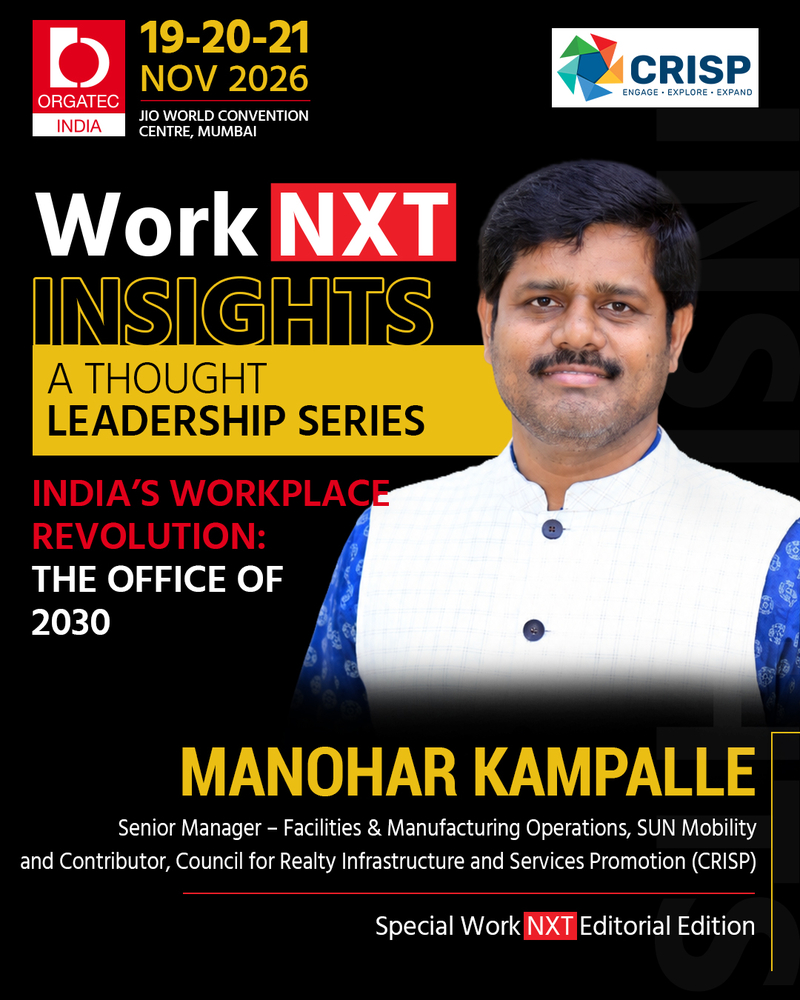
Manohar Kampalle
Senior Manager - Facilities & Manufacturing Operations, SUN Mobility and Contributor, Council for Realty Infrastructure and Services Promotion (CRISP)