



WorkNXT Insights Article
AI and the Future of Workplace Planning A Global Perspective and the Indian Opportunity
AI and the Future of Workplace Planning A Global Perspective and the Indian Opportunity
Artificial Intelligence (AI) is transforming how organisations plan, manage and experience their workplaces. Amid rising operating costs, hybrid work models and growing sustainability commitments, AI offers a strategic opportunity to elevate corporate services from operational support functions to value-driven business enablers.
The Global Perspective
Globally, organisations are leveraging AI, smart building technologies and predictive analytics to enhance workplace efficiency and employee experience. Industry research from JLL and CBRE highlights the growing importance of intelligent facilities management, operational resilience and cost optimisation.
AI-powered occupancy analytics can optimise space utilisation and inform real estate decisions, while predictive maintenance can anticipate equipment failures, reduce downtime and extend asset life. Digital twins enable organisations to simulate building performance and forecast future infrastructure requirements. Integrated workplace platforms can consolidate desk bookings, visitor management, catering and maintenance requests, delivering a seamless employee experience.
The global shift is clear: workplace management is evolving from reactive operations to predictive, data-driven decision-making.
The Indian Opportunity
India's expanding corporate infrastructure, diverse operating environments and increasing focus on productivity create significant opportunities for AI-led workplace transformation.
AI can integrate facilities management, corporate travel, hospitality, transport and employee services into a connected ecosystem. Travel analytics can optimise expenditure and strengthen policy compliance, while intelligent building systems can reduce energy consumption. For multi-location enterprises, centralised dashboards can benchmark space utilisation, maintenance costs and service performance, enabling better resource allocation and consistent service delivery.
Realising this potential requires robust data governance, cybersecurity, employee privacy and effective change management. AI must augment human judgement and professional expertise, not replace them.
The CXO Agenda
As a Services Head, I believe the next frontier lies in creating an integrated, intelligence-led workplace ecosystem. The priorities are to establish reliable data foundations, implement high-impact pilot projects and scale solutions that demonstrate measurable business value.
Success must be assessed through tangible improvements in operating expenditure, asset reliability, energy efficiency, service quality and employee satisfaction-not simply the deployment of technology.
The future of workplace planning is not merely about creating smart buildings; it is about building smarter, more agile and resilient organisations. By combining AI, human expertise and strategic foresight, services leaders can create sustainable, people-centric workplaces that deliver lasting value to employees and the enterprise.
CRISP, as a collective of like-minded trade experts, is making a timely effort to bridge the gap between current industry practices and the demands of the future. By bringing together professionals, sharing knowledge and encouraging collaboration, CRISP aims to build industry readiness, promote innovation and shape the future of workplace planning and corporate services in India
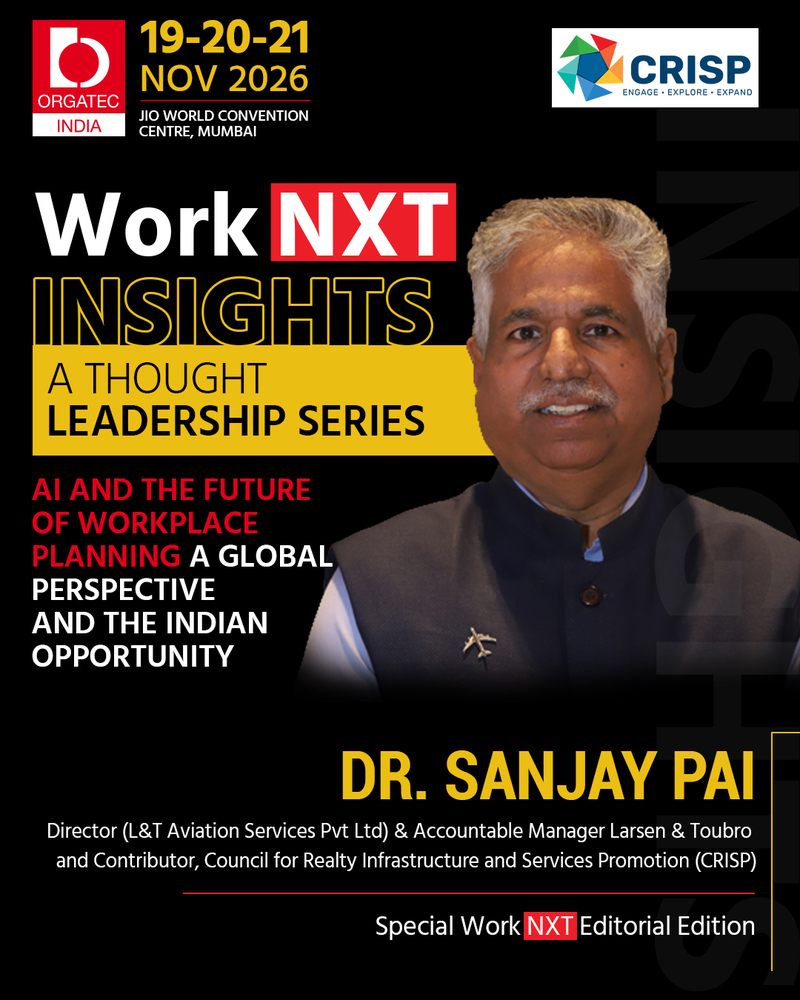
Dr. Sanjay Pai
Director (L&T Aviation Services Pvt Ltd) & Accountable Manager, Larsen & Toubro and Contributor, Council for Realty Infrastructure and Services Promotion (CRISP)