


WorkNXT Insights Article
FROM SUNK COST TO STRATEGIC ASSET: A FACILITIES LEADERSHIP PLAYBOOK
"The narrative around Facilities is stuck. Too many organizations still view their physical footprint as a fixed overhead, a necessary expense to be minimized. But the leaders who get it are shifting the conversation entirely. They're not asking "How much does it cost???" They're asking "What do we get for what we spend?"
Here's a strategic playbook for Facilities leaders ready to reframe the discussion & claim their seat at the value-creation table.
Cost Centre or Value Creator? The answer is Both-But the ratio is shifting
Traditionally, Facilities was classified as a cost centre: fixed overhead, budget line item, unavoidable expense. Today, that framing is not just outdated, it's strategically dangerous.
Facilities has become a value driver because it directly enables three enterprise priorities:
· Human Capital ROI: The workplace is no longer just a seat. It's a tool for collaboration, a lever for productivity & a signal of how the organization values its people.
· Brand Equity: Physical space is a tangible expression of ESG commitments. Sustainability credentials, wellness certifications & community presence all live in the built environment.
· Risk Mitigation: Health, safety & business continuity aren't soft benefits-they're value protection.
The Verdict: Facilities is a managed cost centre that generates value through productivity gains. The goal is to move the conversation from "How much does it cost?" to "What do we get for what we spend???"
Measuring ROI: Move beyond cost per square foot
If you're still measuring Facilities ROI solely on cost per square foot, you're speaking a language your CFO stopped caring about years ago. The new metric is value per square foot & it requires a three-tiered approach.
Tier focus key metrics
Tier 1: Efficiency operational fundamentals cost per occupant, energy intensity (kWh/sq ft), space utilization (%)
Tier 2: Effectiveness experience & outcomes workstation occupancy rates, maintenance resolution time, workplace NPS
Tier 3: Enterprise impact business value creation recruitment cost reduction, absenteeism rates, project delivery speed
Tier 1 keeps the lights on. Tier 2 tells you if the space is working. Tier 3 proves that Facilities is a strategic partner in business performance.
Employee engagement & retention: Facilities is a friction remover
Can Facilities directly influence engagement & retention??? Absolutely, but only if it solves friction.
Employees don't quit over bad carpets. They quit over friction: no quiet space to focus, broken technology in meeting rooms, poor air quality that leaves them foggy by 14:00 hrs.
· Retention: Post-COVID, 65% of workers say they would take a pay cut for a better work environment. A well-designed space signals "We respect your time & wellbeing."
· Engagement: Facilities drives the collision index, the unplanned interactions that spark innovation. If your space actively separates people, engagement drops.
The takeaway is simple: Facilities isn't responsible for culture. But it is responsible for removing the physical barriers that erode it.
What Boards & CEOs actually care about
Boards speak in Risk, Revenue & Reputation. To earn their attention, translate Facilities metrics into their language.
Metric Why It Matters to the Board
Carbon Intensity (tCO₂e/sq ft): Regulatory compliance & investor ESG scores
Cost-to-Headcount Ratio: Is real estate growing faster than hiring??? An efficiency alarm.
Employee NPS by Location: Direct correlation between physical conditions & team performance
Utilization Rate (Peak vs Average): Avoids wasting CAPEX on empty buildings
Downtime/Critical Failures: Hours of work lost due to HVAC or power outages
These aren't Facilities metrics dressed up in business language. They're business metrics that Facilities uniquely owns.
Technology: Strategic investment with OPEX execution
Is technology an operational expense or a strategic investment??? It's both, depending on how you use it.
· If you buy IoT sensors just to track toilet usage, that's OPEX. You're spending money to monitor something that doesn't change decisions.
· If you buy IoT sensors to predict HVAC failures, reduce energy bills by 20% & tell HR when to schedule deep cleans to reduce sick days, that's a strategic investment.
The Rule: Technology becomes strategic when the data it generates is used to make a decision that saves more than 3x its cost. Right sizing a floorplate based on utilization data might save millions in lease renewals. That's not an IT expense, that's a business case.
Communicating value to the C-Suite
Facilities leaders who win are the ones who translate their work into the language of the business.
To the CFO: Use "avoided cost" & "working capital."
"By investing $X in predictive maintenance, we avoid $Y in emergency repairs & extend asset life by five years."
To the CEO: Use "velocity" & "talent."
"Our new agile zones reduce team meeting setup time by 15 minutes per day, saving 60 hours per team annually, that's 1.5 extra productive weeks per year."
The Rule: Always lead with the business outcome, then explain the Facilities action that enabled it. Never the reverse.
The single metric that convinces CEOs
If you need one number to make the case for investment, it's cost per productive hour (or productivity per square foot).
Why: It ties real estate directly to revenue.
Example: Team A works in a poorly lit, noisy space & generates $100/hour per employee. Team B works in a modern, well-designed space and generates $130/hour. The CEO immediately sees that spending $5 per square foot more on lighting & acoustics yields a 30x return in human output.
No other metric bridges the gap between Facilities spend & business performance so clearly.
Thinking of a Facilities Leaders as a CEO
"I would flip the budget approval process. Today, Facilities presents a budget & the CEO approves or reduces it. That's a recipe for cost-cutting, not value creation. In my organization, every C-suite leader-HR, Technology, Sales, Operations-would be required to co-sign the Facilities budget. They are internal clients of the space. This forces HR to own engagement metrics, Technology to own digital infrastructure & Operations to own utilization data. Facilities would no longer be a support department-it would be the orchestrator of the physical experience, with shared accountability across every function."
And the first line item I'd double??? Indoor air quality sensors. Because cognitive performance drops 50% in high-CO₂ environments & that's a CEO-level productivity leak hiding in plain sight.
The playbook is clear. Facilities leaders who reframe their role from cost manager to value creator & who speak the language of risk, revenue & reputation, won't just earn a seat at the table. They'll become indispensable to it."
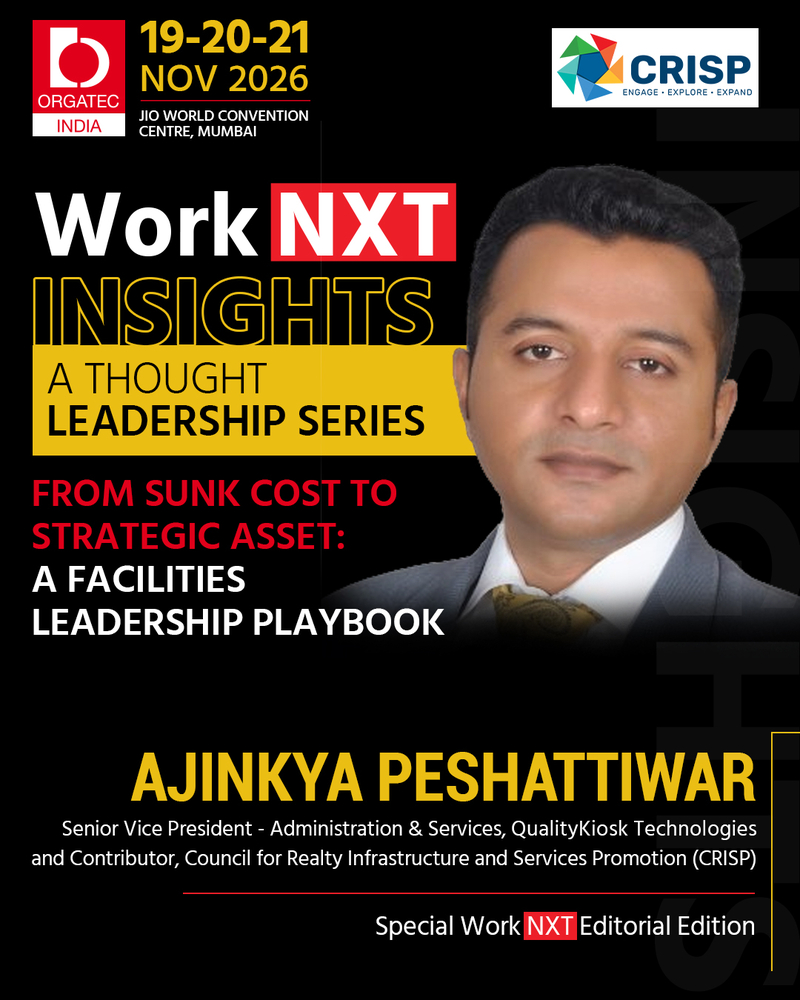
Ajinkya Peshattiwar
Senior Vice President - Administration & Services, QualityKiosk Technologies and Contributor, Council for Realty Infrastructure and Services Promotion (CRISP)